[ sole designer ]
First conversation, reframed:The AI agent became the onboarding
I rebuilt Veezo's first-time experience around its AI agent, so the first conversation becomes the first step in a weekly networking habit.
Context
Veezo helps people make their professional network more useful. Its AI agent adds a conversational layer on top of contacts, connections, calendar and memories - helping users find relevant people, organize relationships, and act on networking opportunities.
As the agent became a central part of the product, onboarding had a new job.
It no longer needed to explain Veezo. It needed to get users to experience its value.
As Veezo's AI agent became central, onboarding's job changed: no longer to explain the app, but to get users to experience its value.
The problem with the first onboarding
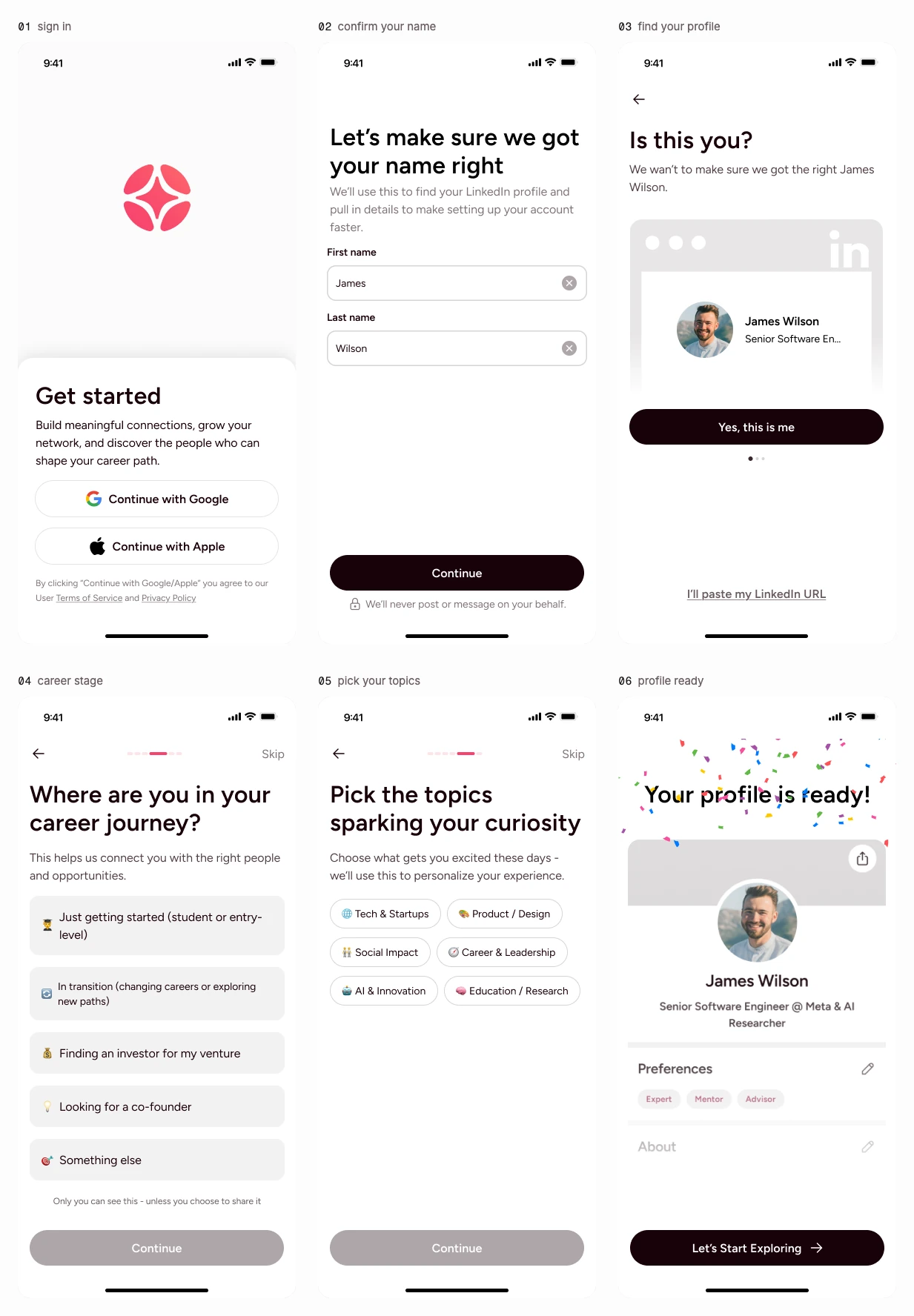
The original onboarding followed a familiar mobile pattern: introduction screens, personalization questions, and then access to the app.
It helped users understand what Veezo was - but left them to figure out what to do with it.
Once inside, users still had to:
- explore the interface.
- discover the AI agent.
- understand its value.
- and decide how networking with Veezo should fit into their routine.
The onboarding ended exactly where the important behavior needed to begin.
The old flow explained what Veezo was, then left users to figure out what to do - it ended exactly where the important behavior needed to begin.
The goal: activation, not completion
The question was no longer:
How do we get users through onboarding?
It became:
How do we get users to experience a behavior worth repeating?
We defined the real activation moment as behavioral:
The user understands that Veezo can regularly introduce them to relevant people - and commits to making space for that interaction every week.
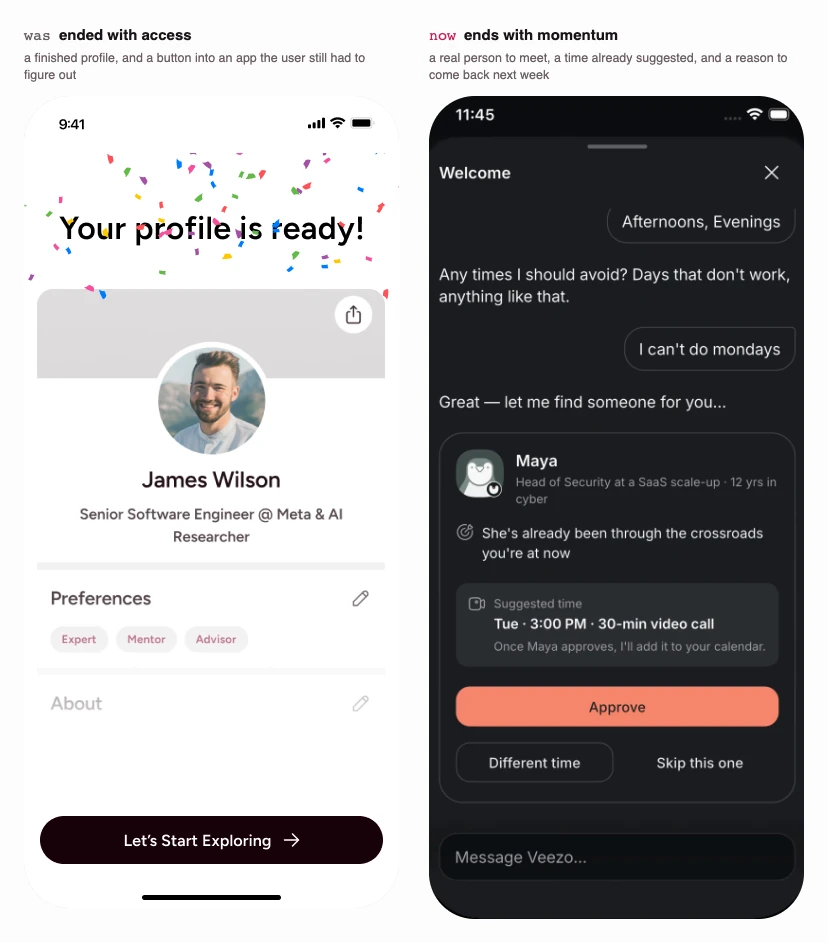
The old onboarding ended with access. The new onboarding needed to end with momentum.
I reframed the goal from getting users through onboarding to getting them to a behavior worth repeating - ending with momentum, not just access.
The shift: onboarding through use
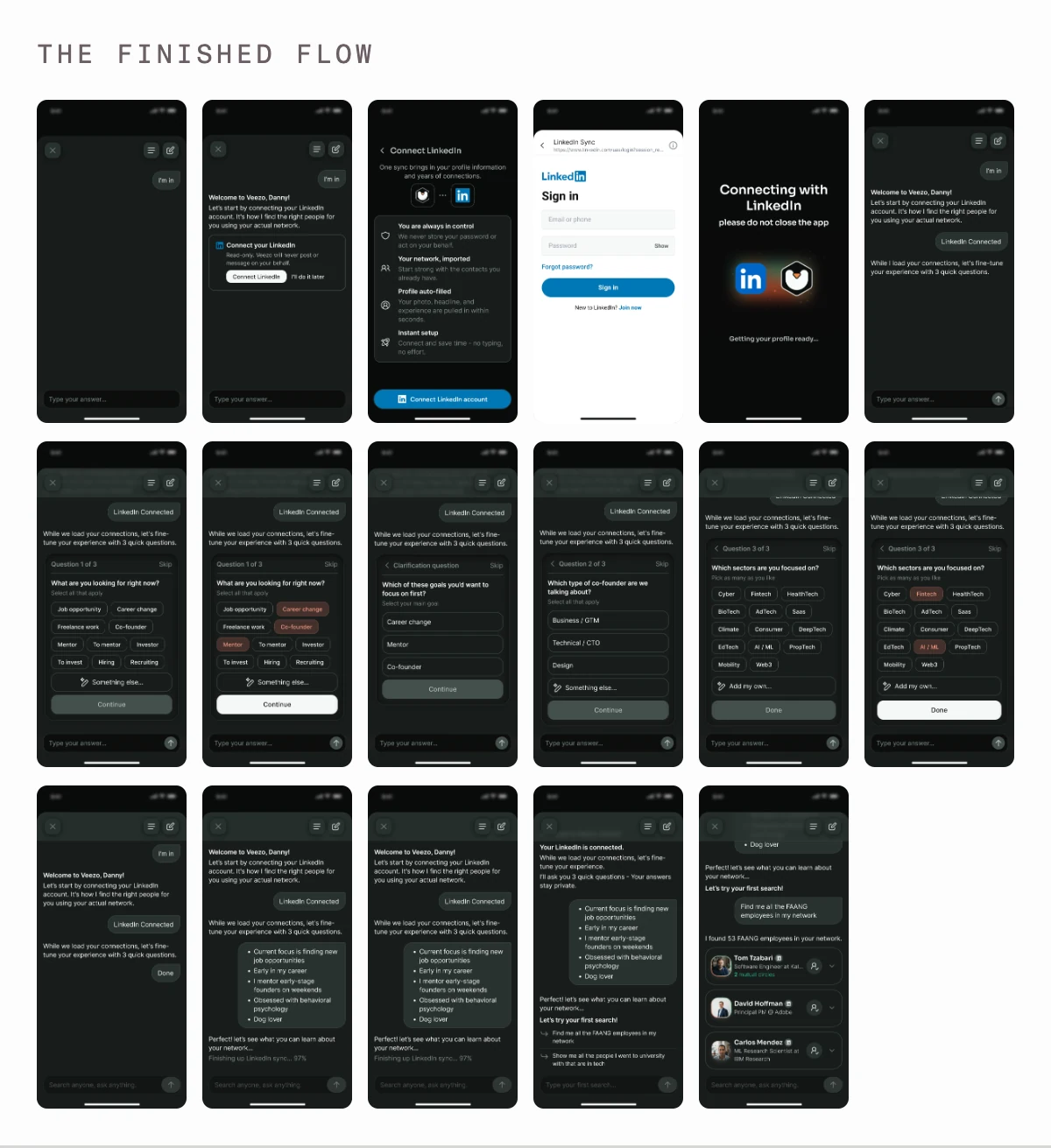
Instead of introducing the AI agent after setup, we made it the first interaction after sign-in. The agent became the onboarding.
The agent became the onboarding - guiding users from inside the product instead of explaining it from the outside.
Rather than describing what Veezo could do, it began doing it with the user: learning their context, clarifying their networking goal, and moving them toward a meaningful first action.
We were inspired by conversational-AI products that reduce traditional onboarding and bring users directly into the core interaction.
But we did not want to simply remove onboarding. Veezo still needed to guide users toward a specific behavior.
Instead of explaining the app first, the AI agent became the onboarding - learning the user's context and moving them toward a real first action, not just removing steps.
Different starting points, one destination
The original onboarding asked generic personalization questions upfront, before users had much context for answering them.
The AI agent allowed personalization to happen progressively - asking only what was needed, when it was needed.
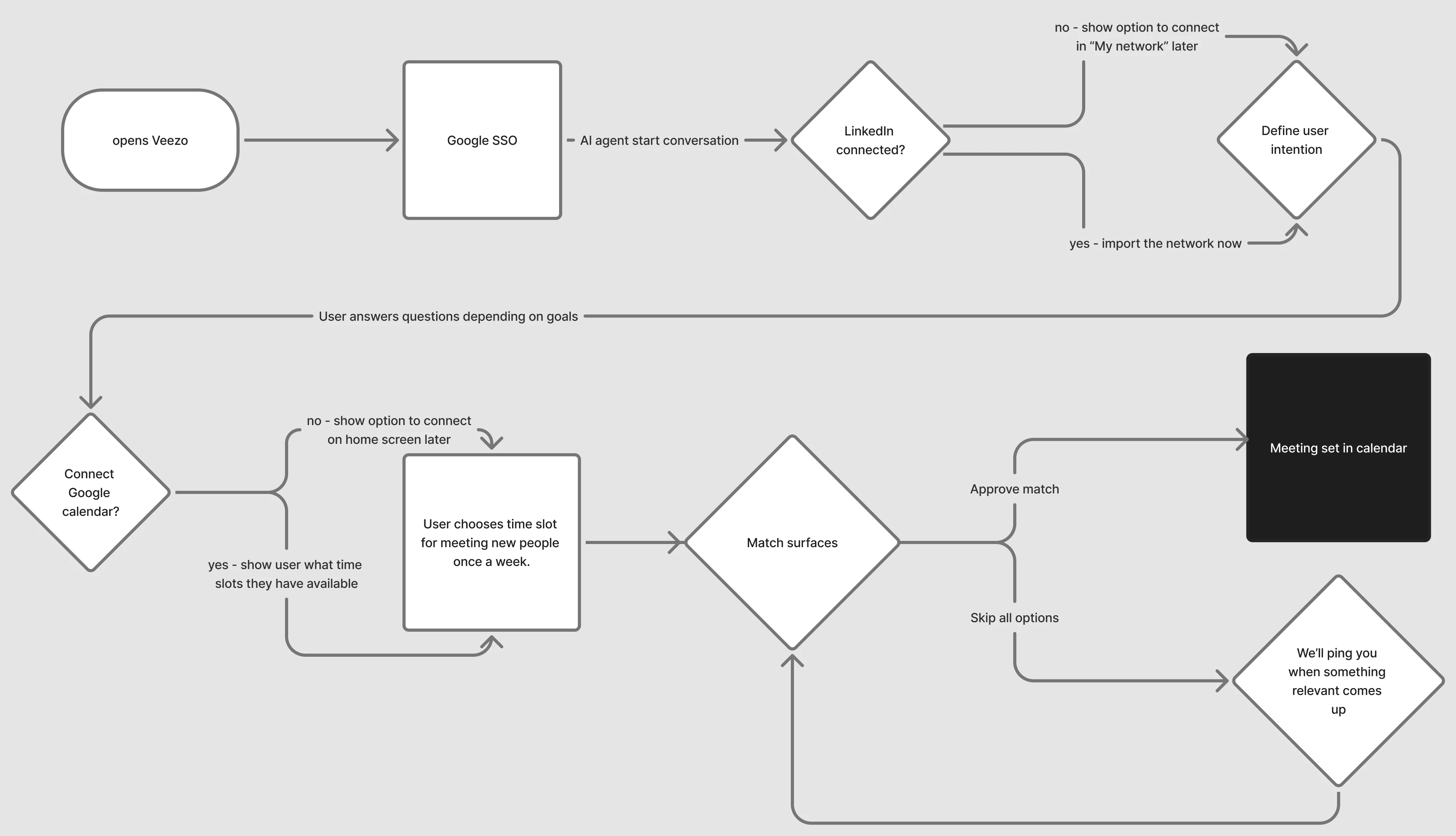
Users could arrive in very different states. Some connected LinkedIn immediately, while others delayed setup. Some knew exactly who they wanted to meet; others needed help defining their goal.
We mapped these entry states so the conversation could adapt while still guiding everyone toward the same outcome:
Meet relevant new people on a recurring basis.
Users arrive in very different states, so the agent personalizes progressively - many paths, one destination: meet relevant new people on a recurring basis.
Networking is valuable, but vague and easy to postpone. The onboarding therefore turns it into a concrete behavior: define a goal, choose a regular time, and let Veezo introduce someone relevant each week.
Different paths. One destination. One behavior worth repeating.
The activation
Build context
Connect relevant sources (Google, LinkedIn, phone contacts) and understand who the user already knows.
Clarify intent
Understand who they want to meet, why, and what they can offer in return.
Create the first match
Use that context to surface a relevant person the user could meet.
Turn it into a recurring behavior
After the first match is approved, establish a regular networking slot and introduce the broader Veezo ecosystem.
Once activated, Veezo works in the background toward the user's networking goal and brings them a relevant person to meet each week. Around that core behavior, users can organize their network, save context about relationships, and schedule meetings.
The weekly introduction is the anchor. The rest of the product supports it.
Once activated, Veezo brings a relevant person to meet each week - the weekly introduction is the anchor, and the rest of the product supports it.
Design outcome
The redesign shifted onboarding from a setup sequence into the first real product experience.
Instead of asking every user to complete the same introductory flow, the AI agent adapts to their context, helps clarify their intent, and leads them toward a meaningful first connection.
Before: onboarding ended when the user entered Veezo.
After: onboarding ends when the user understands why they should come back.
The goal wasn't to teach people how to use Veezo. It was to give them a reason to use it again.
Before, onboarding ended when the user entered Veezo; after, it ends when they understand why to come back - a reason to use it again, not a tutorial.
What happened next
The redesigned onboarding was completed and ready for launch, but the company shut down before the new flow was released.
Because of that, I wasn't able to validate its impact with live users.
Had it launched, I would have measured:
- first meaningful match completion
- meeting approval or scheduling
- conversion to a recurring weekly networking slot
- week-one return rate
- drop-off points in the conversational onboarding
The design was complete, but the behavioral hypothesis remained unvalidated.
The redesign was complete and ready, but the company shut down before launch - so the behavioral hypothesis (weekly-slot conversion, week-one return) stayed unvalidated.